

QUESTION 01
Drift Velocity & Relaxation Time
CBSE Board
A uniform copper conductor of cross-sectional area \( A = 1.0 \times 10^{-7} \text{ m}^2 \)
carries a steady current of \( I = 1.5 \text{ A} \). Assuming electron density is \( n = 8.5
\times 10^{28} \text{ m}^{-3} \), calculate:
(a) Drift velocity (\(v_d\)) of free electrons.
(b) Current density (\(J\)) in the conductor.
(c) Relaxation time (\(\tau\)) if resistivity \(\rho = 1.7 \times 10^{-8} \,\Omega\cdot\text{m}\) and electron mass \(m = 9.1 \times 10^{-31} \text{ kg}\).
(a) Drift velocity (\(v_d\)) of free electrons.
(b) Current density (\(J\)) in the conductor.
(c) Relaxation time (\(\tau\)) if resistivity \(\rho = 1.7 \times 10^{-8} \,\Omega\cdot\text{m}\) and electron mass \(m = 9.1 \times 10^{-31} \text{ kg}\).
Given: \( I = 1.5\text{ A} \), \( A = 10^{-7}\text{ m}^2 \), \( n = 8.5 \times 10^{28}\text{
m}^{-3} \), \( e = 1.6 \times 10^{-19}\text{ C} \)
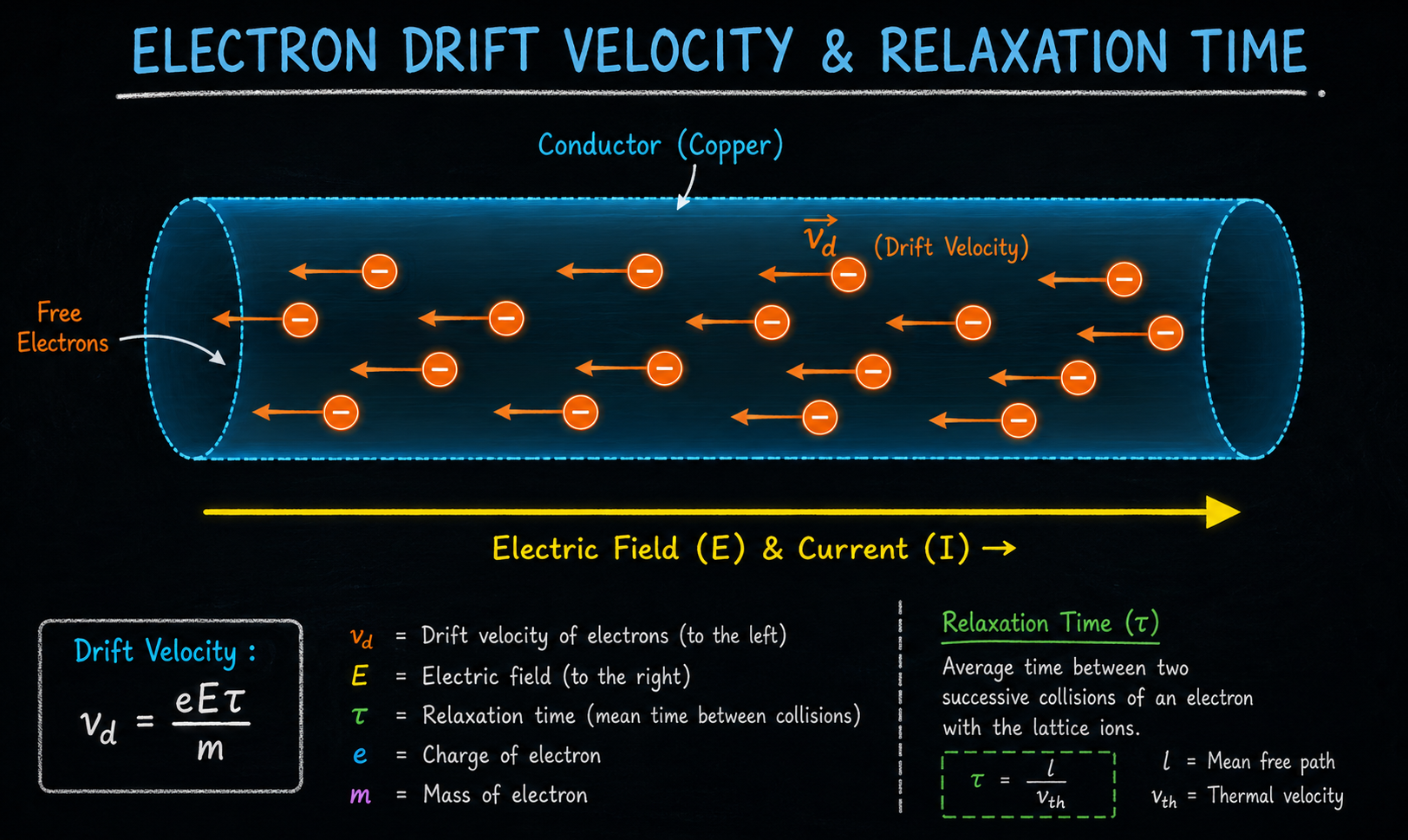
01 / 20
Detailed Solution 01
(a) Drift Velocity (\(v_d\)):
\( I = n e A v_d \implies v_d = \frac{I}{n e A} = \frac{1.5}{8.5 \times 10^{28} \times 1.6 \times 10^{-19} \times 10^{-7}} = 1.10 \text{ mm/s} \)
(b) Current Density (\(J\)):
\( J = \frac{I}{A} = \frac{1.5}{1.0 \times 10^{-7}} = 1.5 \times 10^7 \text{ A/m}^2 \)
(c) Relaxation Time (\(\tau\)):
\( \tau = \frac{m}{n e^2 \rho} = 2.47 \times 10^{-14} \text{ seconds} \)
\( I = n e A v_d \implies v_d = \frac{I}{n e A} = \frac{1.5}{8.5 \times 10^{28} \times 1.6 \times 10^{-19} \times 10^{-7}} = 1.10 \text{ mm/s} \)
(b) Current Density (\(J\)):
\( J = \frac{I}{A} = \frac{1.5}{1.0 \times 10^{-7}} = 1.5 \times 10^7 \text{ A/m}^2 \)
(c) Relaxation Time (\(\tau\)):
\( \tau = \frac{m}{n e^2 \rho} = 2.47 \times 10^{-14} \text{ seconds} \)
QUESTION 02
Temperature Dependence
CBSE / JEE Main
A platinum resistance thermometer has a resistance of \( R_0 = 5.00\,\Omega \) at
\(0^\circ\text{C}\) and \( R_{100} = 5.23\,\Omega \) at \(100^\circ\text{C}\). When inserted
into a hot bath, the resistance becomes \( R_t = 5.795\,\Omega \). Calculate:
(a) Temperature coefficient of resistance (\(\alpha\)) of platinum.
(b) Temperature (\(t\)) of the hot bath.
(a) Temperature coefficient of resistance (\(\alpha\)) of platinum.
(b) Temperature (\(t\)) of the hot bath.
Given: \( R_0 = 5.00\,\Omega \), \( R_{100} = 5.23\,\Omega \), \( R_t = 5.795\,\Omega \)
02 / 20
Detailed Solution 02
(a) Temperature Coefficient (\(\alpha\)):
\( \alpha = \frac{R_{100} - R_0}{100 R_0} = \frac{0.23}{500} = 4.6 \times 10^{-4} \,^\circ\text{C}^{-1} \)
(b) Temperature of Hot Bath (\(t\)):
\( t = \frac{R_t - R_0}{\alpha R_0} = \frac{0.795}{0.23} \times 100 = 345.65^\circ\text{C} \)
\( \alpha = \frac{R_{100} - R_0}{100 R_0} = \frac{0.23}{500} = 4.6 \times 10^{-4} \,^\circ\text{C}^{-1} \)
(b) Temperature of Hot Bath (\(t\)):
\( t = \frac{R_t - R_0}{\alpha R_0} = \frac{0.795}{0.23} \times 100 = 345.65^\circ\text{C} \)
QUESTION 03
Infinite Resistor Ladder
JEE Mains Special
An infinite network of identical resistors, each of resistance \( R = 2.0\,\Omega \), is
connected across terminals A and B as shown. Determine the equivalent resistance (\(R_{AB}\)) of
this infinite ladder network.
Given: Each resistor \( R = 2.0\,\Omega \), Infinite repeating unit network.
.%20Terminals%20A%20and%20B%20marked%20on%20left%20wi.png)
03 / 20
Detailed Solution 03
Equivalent Resistance Method:
Let total equivalent resistance across A-B be \( R_{AB} = X \).
\( X = R + \frac{R X}{R + X} \implies X^2 - R X - R^2 = 0 \)
For \( R = 2.0\,\Omega \): \( X^2 - 2X - 4 = 0 \implies X = 1 + \sqrt{5} = 3.236 \,\Omega \)
Let total equivalent resistance across A-B be \( R_{AB} = X \).
\( X = R + \frac{R X}{R + X} \implies X^2 - R X - R^2 = 0 \)
For \( R = 2.0\,\Omega \): \( X^2 - 2X - 4 = 0 \implies X = 1 + \sqrt{5} = 3.236 \,\Omega \)
QUESTION 04
Mixed Cell Grouping & Max Power
CBSE / JEE Main
A battery consists of \( n = 4 \) parallel rows, where each row contains \( m = 6 \) identical
cells connected in series. Each cell has EMF \( e = 2.0\text{ V} \) and internal resistance \( r
= 0.5\,\Omega \).
(a) Determine total EMF (\(E_{eq}\)) and internal resistance (\(r_{eq}\)) of the battery.
(b) Find the external load resistance (\(R\)) for maximum power transfer and calculate maximum power (\(P_{max}\)).
(a) Determine total EMF (\(E_{eq}\)) and internal resistance (\(r_{eq}\)) of the battery.
(b) Find the external load resistance (\(R\)) for maximum power transfer and calculate maximum power (\(P_{max}\)).
Given: \( m = 6 \) (in series), \( n = 4 \) (parallel rows), \( e = 2.0\text{V} \), \( r =
0.5\,\Omega \).
%20connected%20to%20load%20resistor%20R%20on%20dark%20blackboard%20canvas%20(.png)
04 / 20
Detailed Solution 04
(a) Battery Equivalent EMF & Resistance:
\( E_{eq} = m \cdot e = 6 \times 2.0 = 12\text{ V} \)
\( r_{eq} = \frac{m r}{n} = \frac{6 \times 0.5}{4} = 0.75\,\Omega \)
(b) Max Power Transfer:
\( R = r_{eq} = 0.75\,\Omega \)
\( I = \frac{12}{0.75 + 0.75} = 8\text{ A} \implies P_{max} = I^2 R = 64 \times 0.75 = 48\text{ Watts} \)
\( E_{eq} = m \cdot e = 6 \times 2.0 = 12\text{ V} \)
\( r_{eq} = \frac{m r}{n} = \frac{6 \times 0.5}{4} = 0.75\,\Omega \)
(b) Max Power Transfer:
\( R = r_{eq} = 0.75\,\Omega \)
\( I = \frac{12}{0.75 + 0.75} = 8\text{ A} \implies P_{max} = I^2 R = 64 \times 0.75 = 48\text{ Watts} \)
QUESTION 05
Kirchhoff's Rules (KVL / KCL)
CBSE Board Core
In the multi-loop circuit shown, determine branch currents \(I_1\), \(I_2\), and \(I_3\) using
Kirchhoff's Voltage Law (KVL).
(Given: Battery EMFs \(E_1 = 10\text{ V}\), \(E_2 = 4\text{ V}\); Resistors \(R_1 = 2\,\Omega\), \(R_2 = 4\,\Omega\), central resistor \(R_3 = 1\,\Omega\)).
(Given: Battery EMFs \(E_1 = 10\text{ V}\), \(E_2 = 4\text{ V}\); Resistors \(R_1 = 2\,\Omega\), \(R_2 = 4\,\Omega\), central resistor \(R_3 = 1\,\Omega\)).
Given: \( E_1 = 10\text{V}, E_2 = 4\text{V}, R_1 = 2\,\Omega, R_2 = 4\,\Omega, R_3 = 1\,\Omega
\)
%20circuit%20diagram%20on%20dark%20blackboard%20background%20(%2307090c).%20Outer%20rectangle%20in%203.5px%20cyan%20wire%20(%23.png)
05 / 20
Detailed Solution 05
Applying KCL & KVL:
\( I_3 = I_1 + I_2 \)
Loop 1: \( 10 - 2 I_1 - 1(I_1 + I_2) = 0 \implies 3 I_1 + I_2 = 10 \)
Loop 2: \( 4 - 4 I_2 - 1(I_1 + I_2) = 0 \implies I_1 + 5 I_2 = 4 \)
Solving: \( I_2 = 0.143\text{ A} \), \( I_1 = 3.285\text{ A} \), \( I_3 = 3.428\text{ A} \)
\( I_3 = I_1 + I_2 \)
Loop 1: \( 10 - 2 I_1 - 1(I_1 + I_2) = 0 \implies 3 I_1 + I_2 = 10 \)
Loop 2: \( 4 - 4 I_2 - 1(I_1 + I_2) = 0 \implies I_1 + 5 I_2 = 4 \)
Solving: \( I_2 = 0.143\text{ A} \), \( I_1 = 3.285\text{ A} \), \( I_3 = 3.428\text{ A} \)
QUESTION 06
Wheatstone Bridge Balance
JEE Mains / CBSE
A Wheatstone bridge has four arms with resistances \( P = 10\,\Omega \), \( Q = 15\,\Omega \),
\( R = 20\,\Omega \), and \( S = 30\,\Omega \). A galvanometer \( G = 50\,\Omega \) is connected
across B-D and a battery of \( E = 6.0\text{ V} \) is across A-C.
(a) Prove whether the bridge is balanced.
(b) Find the total equivalent resistance (\(R_{AC}\)) and total current drawn from the battery.
(a) Prove whether the bridge is balanced.
(b) Find the total equivalent resistance (\(R_{AC}\)) and total current drawn from the battery.
Given: \( P=10\,\Omega, Q=15\,\Omega, R=20\,\Omega, S=30\,\Omega, E=6\text{V} \).
.%20Four%20resistor%20arms%20arranged%20in%20a%20diamond%20polygon%20with%20vertice.png)
06 / 20
Detailed Solution 06
(a) Balance Condition:
\( \frac{P}{Q} = \frac{10}{15} = \frac{2}{3} \) and \( \frac{R}{S} = \frac{20}{30} = \frac{2}{3} \). Since \( \frac{P}{Q} = \frac{R}{S} \), the bridge is balanced (\(I_G = 0\)).
(b) Equivalent Resistance:
\( R_{AC} = \frac{(10+15)(20+30)}{(10+15)+(20+30)} = \frac{25 \times 50}{75} = 16.67 \,\Omega \)
\( I = \frac{6.0}{16.67} = 0.36\text{ A} \)
\( \frac{P}{Q} = \frac{10}{15} = \frac{2}{3} \) and \( \frac{R}{S} = \frac{20}{30} = \frac{2}{3} \). Since \( \frac{P}{Q} = \frac{R}{S} \), the bridge is balanced (\(I_G = 0\)).
(b) Equivalent Resistance:
\( R_{AC} = \frac{(10+15)(20+30)}{(10+15)+(20+30)} = \frac{25 \times 50}{75} = 16.67 \,\Omega \)
\( I = \frac{6.0}{16.67} = 0.36\text{ A} \)
QUESTION 07
Meter Bridge Experiment
CBSE Board Practical
In a meter bridge experiment, null point is obtained at \( l_1 = 33.7\text{ cm} \) from end A
when a standard resistance \( R = 12.0\,\Omega \) is in the left gap and unknown resistance \( S
\) is in the right gap.
(a) Calculate the unknown resistance \(S\).
(b) If \(R\) and \(S\) are interchanged, calculate the new balance length (\(l_2\)).
(c) Why are thick copper strips used to connect components in a meter bridge?
(a) Calculate the unknown resistance \(S\).
(b) If \(R\) and \(S\) are interchanged, calculate the new balance length (\(l_2\)).
(c) Why are thick copper strips used to connect components in a meter bridge?
Given: Left gap \( R = 12.0\,\Omega \), Balance length \( l_1 = 33.7\text{ cm} \).
.%20Features%201m%20constantan%20wire%20AB%20over%20a%20wooden%20base%20with%20thi.png)
07 / 20
Detailed Solution 07
(a) Unknown Resistance (\(S\)):
\( \frac{12.0}{S} = \frac{33.7}{100 - 33.7} \implies S = 12.0 \times \frac{66.3}{33.7} = 23.61 \,\Omega \)
(b) Interchanging \(R\) and \(S\):
New balance length \( l_2 = 100 - 33.7 = 66.3\text{ cm} \)
(c) Copper Strips:
Thick copper strips have very large area and negligible resistance, reducing end resistance errors.
\( \frac{12.0}{S} = \frac{33.7}{100 - 33.7} \implies S = 12.0 \times \frac{66.3}{33.7} = 23.61 \,\Omega \)
(b) Interchanging \(R\) and \(S\):
New balance length \( l_2 = 100 - 33.7 = 66.3\text{ cm} \)
(c) Copper Strips:
Thick copper strips have very large area and negligible resistance, reducing end resistance errors.
QUESTION 08
Potentiometer - EMF Comparison
CBSE Board Classic
A potentiometer wire \( AB \) of length \( L = 100\text{ cm} \) has a resistance \( R_w =
10\,\Omega \). It is connected in series with driver cell \( E_0 = 4.0\text{ V} \) and series
resistor \( R_s = 30\,\Omega \).
(a) Calculate potential gradient (\(k\)) along the wire.
(b) Two cells \(E_1\) and \(E_2\) produce balance lengths \(l_1 = 60\text{ cm}\) and \(l_2 = 45\text{ cm}\) respectively. Determine the ratio \(E_1 / E_2\) and exact value of \(E_1\).
(a) Calculate potential gradient (\(k\)) along the wire.
(b) Two cells \(E_1\) and \(E_2\) produce balance lengths \(l_1 = 60\text{ cm}\) and \(l_2 = 45\text{ cm}\) respectively. Determine the ratio \(E_1 / E_2\) and exact value of \(E_1\).
Given: \( L = 100\text{cm}, R_w = 10\,\Omega, E_0 = 4\text{V}, R_s = 30\,\Omega, l_1 =
60\text{cm}, l_2 = 45\text{cm} \).
..png)
08 / 20
Detailed Solution 08
(a) Potential Gradient (\(k\)):
\( I_0 = \frac{4.0}{10 + 30} = 0.1\text{ A} \implies V_{AB} = 0.1 \times 10 = 1.0\text{ V} \)
\( k = \frac{1.0\text{ V}}{100\text{ cm}} = 0.01 \text{ V/cm} = 1.0 \text{ V/m} \)
(b) Ratio & Value of \(E_1\):
\( \frac{E_1}{E_2} = \frac{60}{45} = \frac{4}{3} = 1.33 \)
\( E_1 = k \cdot l_1 = 0.01 \times 60 = 0.60 \text{ Volts} \)
\( I_0 = \frac{4.0}{10 + 30} = 0.1\text{ A} \implies V_{AB} = 0.1 \times 10 = 1.0\text{ V} \)
\( k = \frac{1.0\text{ V}}{100\text{ cm}} = 0.01 \text{ V/cm} = 1.0 \text{ V/m} \)
(b) Ratio & Value of \(E_1\):
\( \frac{E_1}{E_2} = \frac{60}{45} = \frac{4}{3} = 1.33 \)
\( E_1 = k \cdot l_1 = 0.01 \times 60 = 0.60 \text{ Volts} \)
QUESTION 09
Potentiometer - Internal Resistance
CBSE / JEE Main
A cell of EMF \( E = 1.5\text{ V} \) gives a balance length of \( l_1 = 75.0\text{ cm} \) on a
potentiometer wire when the secondary circuit key is open. When a resistance box \( R =
9.5\,\Omega \) is shunted across the cell, the balance length reduces to \( l_2 = 60.0\text{ cm}
\).
(a) Calculate internal resistance (\(r\)) of the cell.
(b) Explain why a potentiometer is preferred over a voltmeter for measuring exact EMF of a cell.
(a) Calculate internal resistance (\(r\)) of the cell.
(b) Explain why a potentiometer is preferred over a voltmeter for measuring exact EMF of a cell.
Given: \( l_1 = 75.0\text{cm} \) (open circuit), \( l_2 = 60.0\text{cm} \) (closed circuit), \(
R = 9.5\,\Omega \).
.%20Primary%20wire%20AB%20drawn%20as%20thick%20bright%20yel.png)
09 / 20
Detailed Solution 09
(a) Internal Resistance (\(r\)):
\( r = R \left( \frac{l_1}{l_2} - 1 \right) = 9.5 \left( \frac{75.0}{60.0} - 1 \right) = 9.5 \times 0.25 = 2.375 \,\Omega \)
(b) Advantage of Potentiometer:
Potentiometer draws zero current at balance point (null deflection), measuring true EMF \(E\). A voltmeter draws current, measuring terminal voltage \(V < E\).
\( r = R \left( \frac{l_1}{l_2} - 1 \right) = 9.5 \left( \frac{75.0}{60.0} - 1 \right) = 9.5 \times 0.25 = 2.375 \,\Omega \)
(b) Advantage of Potentiometer:
Potentiometer draws zero current at balance point (null deflection), measuring true EMF \(E\). A voltmeter draws current, measuring terminal voltage \(V < E\).
QUESTION 10
Frustum Conductor Analysis
JEE Mains Advanced
A conductor of length \(L\) and non-uniform cross-section is in the shape of a truncated
cone (frustum) with radii \(a\) and \(b\) (\(b > a\)) at its ends. It carries a steady
current \(I\).
(a) Derive expression for total resistance (\(R\)) of the frustum in terms of resistivity \(\rho\), length \(L\), and radii \(a, b\).
(b) Determine how Electric Field \(E(x)\) and Drift Velocity \(v_d(x)\) vary along length \(x\) from end \(a\) to \(b\).
(a) Derive expression for total resistance (\(R\)) of the frustum in terms of resistivity \(\rho\), length \(L\), and radii \(a, b\).
(b) Determine how Electric Field \(E(x)\) and Drift Velocity \(v_d(x)\) vary along length \(x\) from end \(a\) to \(b\).
Given: Frustum conductor, Radii \(a\) and \(b\), Length \(L\), Resistivity \(\rho\).
.%20Conductor%20oriented%20horizontally%20with%20smaller%20circular%20end%20.png)
10 / 20
Detailed Solution 10
(a) Frustum Resistance Integration:
Radius: \( r(x) = a + \frac{b - a}{L} x \)
\( dR = \frac{\rho dx}{\pi [r(x)]^2} \implies R = \int_0^L dR = \frac{\rho L}{\pi a b} \)
(b) Field & Velocity Variation:
\( E(x) = \frac{\rho I}{\pi r(x)^2} \propto \frac{1}{r(x)^2} \)
\( v_d(x) = \frac{I}{n e \pi r(x)^2} \propto \frac{1}{r(x)^2} \)
Radius: \( r(x) = a + \frac{b - a}{L} x \)
\( dR = \frac{\rho dx}{\pi [r(x)]^2} \implies R = \int_0^L dR = \frac{\rho L}{\pi a b} \)
(b) Field & Velocity Variation:
\( E(x) = \frac{\rho I}{\pi r(x)^2} \propto \frac{1}{r(x)^2} \)
\( v_d(x) = \frac{I}{n e \pi r(x)^2} \propto \frac{1}{r(x)^2} \)
QUESTION 11
Cube Resistor Network
JEE Mains / Advanced
Twelve identical resistors, each of resistance \(R = 6.0\,\Omega\), form a 3D skeletal cube.
A potential difference \(V = 10\text{ V}\) is applied across the body diagonal terminals A
and G.
(a) Calculate total equivalent resistance (\(R_{eq}\)) across body diagonal A-G.
(b) Calculate total current drawn from the voltage source.
(a) Calculate total equivalent resistance (\(R_{eq}\)) across body diagonal A-G.
(b) Calculate total current drawn from the voltage source.
Given: 12 cube resistors \(R = 6.0\,\Omega\), Body diagonal terminals A-G, \(V =
10\text{V}\).
.%20Twelve%20identical%20resistors%20(each%20R%20%3D%206.0%CE%A9)%20fo.png)
11 / 20
Detailed Solution 11
(a) Symmetry Analysis:
Current entering A (\(3I\)) splits equally into 3 branches at A (\(I\) each), then into 6 edges (\(I/2\) each), and recombines at G (\(3I\)).
Total Potential Drop: \( V = I R + \frac{I}{2} R + I R = \frac{5}{2} I R \)
Since total current is \(I_{total} = 3I\):
\( R_{eq} = \frac{V}{I_{total}} = \frac{\frac{5}{2} I R}{3 I} = \frac{5}{6} R \)
For \(R = 6.0\,\Omega\): \( R_{eq} = \frac{5}{6} \times 6 = 5.0\,\Omega \)
(b) Total Current:
\( I_{total} = \frac{V}{R_{eq}} = \frac{10}{5.0} = 2.0\text{ Amperes} \)
Current entering A (\(3I\)) splits equally into 3 branches at A (\(I\) each), then into 6 edges (\(I/2\) each), and recombines at G (\(3I\)).
Total Potential Drop: \( V = I R + \frac{I}{2} R + I R = \frac{5}{2} I R \)
Since total current is \(I_{total} = 3I\):
\( R_{eq} = \frac{V}{I_{total}} = \frac{\frac{5}{2} I R}{3 I} = \frac{5}{6} R \)
For \(R = 6.0\,\Omega\): \( R_{eq} = \frac{5}{6} \times 6 = 5.0\,\Omega \)
(b) Total Current:
\( I_{total} = \frac{V}{R_{eq}} = \frac{10}{5.0} = 2.0\text{ Amperes} \)
QUESTION 12
Delta-Wye (Δ-Y) Conversion
JEE Advanced Special
In an unbalanced bridge circuit where central branch resistors form a Delta loop
(\(R_A=3\Omega, R_B=6\Omega, R_C=3\Omega\)), apply Delta-Wye (\(\Delta\)-Y) transformation.
(a) Calculate equivalent Wye resistors (\(R_1, R_2, R_3\)).
(b) Determine total equivalent circuit resistance.
(a) Calculate equivalent Wye resistors (\(R_1, R_2, R_3\)).
(b) Determine total equivalent circuit resistance.
Given: Delta loop resistors \(R_A=3\Omega, R_B=6\Omega, R_C=3\Omega\).
%20resistor%20network%20transformation%20schematic%20on%20dark%20background%20(%2307090c).%20Left%20section%20shows%20triangular%20Delta%20(%CE%94)%20resistor%20lo.png)
12 / 20
Detailed Solution 12
Delta-Wye Formula:
Sum of Delta resistors: \( S_{sum} = R_A + R_B + R_C = 3 + 6 + 3 = 12\,\Omega \)
\( R_1 = \frac{R_A R_B}{S_{sum}} = \frac{3 \times 6}{12} = 1.5\,\Omega \)
\( R_2 = \frac{R_A R_C}{S_{sum}} = \frac{3 \times 3}{12} = 0.75\,\Omega \)
\( R_3 = \frac{R_B R_C}{S_{sum}} = \frac{6 \times 3}{12} = 1.5\,\Omega \)
Sum of Delta resistors: \( S_{sum} = R_A + R_B + R_C = 3 + 6 + 3 = 12\,\Omega \)
\( R_1 = \frac{R_A R_B}{S_{sum}} = \frac{3 \times 6}{12} = 1.5\,\Omega \)
\( R_2 = \frac{R_A R_C}{S_{sum}} = \frac{3 \times 3}{12} = 0.75\,\Omega \)
\( R_3 = \frac{R_B R_C}{S_{sum}} = \frac{6 \times 3}{12} = 1.5\,\Omega \)
QUESTION 13
Symmetrical Lattice Network
JEE Mains / Advanced
A symmetrical bridge lattice network consists of 5 resistors each of resistance \(R =
4.0\,\Omega\) connected across A and B.
(a) Identify equipotential nodes using mirror symmetry.
(b) Calculate equivalent resistance (\(R_{AB}\)).
(a) Identify equipotential nodes using mirror symmetry.
(b) Calculate equivalent resistance (\(R_{AB}\)).
Given: 5 identical resistors \(R = 4.0\,\Omega\), Mirror symmetry along perpendicular axis.
.%20Five%20identical%20resistors%20(R%20%3D%204.0%CE%A9)%20arranged%20in%20diamond%20latt.png)
13 / 20
Detailed Solution 13
Mirror Symmetry Method:
Perpendicular axis through central resistor bisects the circuit into symmetric halves.
Top and bottom nodes are at equal potential, so zero current flows through central vertical resistor.
Removing central resistor gives two parallel branches of \(2R\) each:
\( R_{AB} = \frac{2R \times 2R}{2R + 2R} = R = 4.0\,\Omega \)
Perpendicular axis through central resistor bisects the circuit into symmetric halves.
Top and bottom nodes are at equal potential, so zero current flows through central vertical resistor.
Removing central resistor gives two parallel branches of \(2R\) each:
\( R_{AB} = \frac{2R \times 2R}{2R + 2R} = R = 4.0\,\Omega \)
QUESTION 14
Real Battery Charging vs Discharging
CBSE Board Core
A storage battery of EMF \(E = 12\text{ V}\) and internal resistance \(r = 0.5\,\Omega\) is
being charged by a \(120\text{ V}\) DC supply using a series resistor \(R = 11.5\,\Omega\).
(a) Calculate charging current (\(I\)).
(b) Calculate terminal voltage (\(V_{term}\)) of the battery during charging.
(c) What is the purpose of the series resistor \(R\)?
(a) Calculate charging current (\(I\)).
(b) Calculate terminal voltage (\(V_{term}\)) of the battery during charging.
(c) What is the purpose of the series resistor \(R\)?
Given: \( E = 12\text{V}, r = 0.5\,\Omega, V_{supply} = 120\text{V}, R = 11.5\,\Omega \).
.%20Outer%20rectangular%20loop%20in%20cy.png)
14 / 20
Detailed Solution 14
(a) Charging Current (\(I\)):
Net effective EMF: \( E_{net} = V_{supply} - E = 120 - 12 = 108\text{ V} \)
Total resistance: \( R_{total} = R + r = 11.5 + 0.5 = 12.0\,\Omega \)
\( I = \frac{108}{12.0} = 9.0\text{ Amperes} \)
(b) Terminal Voltage during Charging:
\( V_{term} = E + I r = 12 + (9.0 \times 0.5) = 12 + 4.5 = 16.5\text{ Volts} \)
(c) Purpose of Series Resistor:
Limits high charging current to prevent damage to battery and supply.
Net effective EMF: \( E_{net} = V_{supply} - E = 120 - 12 = 108\text{ V} \)
Total resistance: \( R_{total} = R + r = 11.5 + 0.5 = 12.0\,\Omega \)
\( I = \frac{108}{12.0} = 9.0\text{ Amperes} \)
(b) Terminal Voltage during Charging:
\( V_{term} = E + I r = 12 + (9.0 \times 0.5) = 12 + 4.5 = 16.5\text{ Volts} \)
(c) Purpose of Series Resistor:
Limits high charging current to prevent damage to battery and supply.
QUESTION 15
RC Circuit Transient Analysis
JEE Mains Special
A capacitor of capacitance \(C = 100\,\mu\text{F}\) is charged through a resistor \(R =
20\,\text{k}\Omega\) by a battery of \(V_0 = 12\text{ V}\).
(a) Calculate time constant (\(\tau = RC\)) of the circuit.
(b) Calculate charge \(q(t)\) on the capacitor at \(t = \tau\).
(c) Calculate maximum current \(I_{max}\) at \(t = 0\).
(a) Calculate time constant (\(\tau = RC\)) of the circuit.
(b) Calculate charge \(q(t)\) on the capacitor at \(t = \tau\).
(c) Calculate maximum current \(I_{max}\) at \(t = 0\).
Given: \( C = 100\,\mu\text{F}, R = 20\,\text{k}\Omega, V_0 = 12\text{V} \).
.%20Loop%20in%20cyan%20(%2338bdf8).%20Left%20branch%20contains%20DC%20voltag.png)
15 / 20
Detailed Solution 15
(a) Time Constant (\(\tau\)):
\( \tau = R C = (20 \times 10^3 \,\Omega) \times (100 \times 10^{-6} \text{ F}) = 2.0\text{ seconds} \)
(b) Charge at \(t = \tau\):
Max charge \( Q_0 = C V_0 = 100 \mu\text{F} \times 12\text{V} = 1.2 \text{ mC} \)
\( q(\tau) = Q_0 (1 - e^{-1}) = 1.2 \times (1 - 0.368) = 0.758 \text{ mC} \) (63.2% of max charge)
(c) Maximum Current:
\( I_{max} = \frac{V_0}{R} = \frac{12}{20 \times 10^3} = 0.6 \text{ mA} \)
\( \tau = R C = (20 \times 10^3 \,\Omega) \times (100 \times 10^{-6} \text{ F}) = 2.0\text{ seconds} \)
(b) Charge at \(t = \tau\):
Max charge \( Q_0 = C V_0 = 100 \mu\text{F} \times 12\text{V} = 1.2 \text{ mC} \)
\( q(\tau) = Q_0 (1 - e^{-1}) = 1.2 \times (1 - 0.368) = 0.758 \text{ mC} \) (63.2% of max charge)
(c) Maximum Current:
\( I_{max} = \frac{V_0}{R} = \frac{12}{20 \times 10^3} = 0.6 \text{ mA} \)
QUESTION 16
Non-Uniform Resistivity Integration
JEE Advanced Special
A cylindrical conductor of length \(L = 2.0\text{ m}\) and cross-sectional area \(A = 4.0
\times 10^{-6} \text{ m}^2\) has non-uniform resistivity varying along its length as
\(\rho(x) = \rho_0 (1 + \alpha x)\), where \(\rho_0 = 1.0 \times 10^{-6}
\,\Omega\cdot\text{m}\) and \(\alpha = 0.5\text{ m}^{-1}\).
(a) Derive and calculate total resistance (\(R\)) of the conductor.
(b) Find potential difference across first half (\(x = 0\) to \(1.0\text{m}\)) when carrying current \(I = 2\text{A}\).
(a) Derive and calculate total resistance (\(R\)) of the conductor.
(b) Find potential difference across first half (\(x = 0\) to \(1.0\text{m}\)) when carrying current \(I = 2\text{A}\).
Given: \( L = 2.0\text{m}, A = 4 \times 10^{-6}\text{m}^2, \rho_0 =
10^{-6}\,\Omega\cdot\text{m}, \alpha = 0.5\text{m}^{-1} \).
.%20A%20360px%20long%20cylindrical%20conductor%20body%20fill.png)
16 / 20
Detailed Solution 16
(a) Total Resistance Integration:
\( R = \int_0^L \frac{\rho_0 (1 + \alpha x) dx}{A} = \frac{\rho_0 L}{A} \left( 1 + \frac{\alpha L}{2} \right) \)
\( R = \frac{10^{-6} \times 2.0}{4.0 \times 10^{-6}} \left( 1 + \frac{0.5 \times 2.0}{2} \right) = 0.5 \times 1.5 = 0.75 \,\Omega \)
(b) Voltage drop across first half:
\( R_{half} = \frac{10^{-6} \times 1.0}{4.0 \times 10^{-6}} \left( 1 + \frac{0.5 \times 1.0}{2} \right) = 0.3125 \,\Omega \)
\( V_{half} = 2.0 \times 0.3125 = 0.625\text{ Volts} \)
\( R = \int_0^L \frac{\rho_0 (1 + \alpha x) dx}{A} = \frac{\rho_0 L}{A} \left( 1 + \frac{\alpha L}{2} \right) \)
\( R = \frac{10^{-6} \times 2.0}{4.0 \times 10^{-6}} \left( 1 + \frac{0.5 \times 2.0}{2} \right) = 0.5 \times 1.5 = 0.75 \,\Omega \)
(b) Voltage drop across first half:
\( R_{half} = \frac{10^{-6} \times 1.0}{4.0 \times 10^{-6}} \left( 1 + \frac{0.5 \times 1.0}{2} \right) = 0.3125 \,\Omega \)
\( V_{half} = 2.0 \times 0.3125 = 0.625\text{ Volts} \)
QUESTION 17
Carey Foster Bridge
CBSE Practical / JEE
In a Carey Foster bridge, two nearly equal resistances \(X\) and \(Y\) give balance length
\(l_1 = 48.5\text{ cm}\). When \(X\) and \(Y\) are interchanged, balance length becomes
\(l_2 = 51.5\text{ cm}\). Resistance per unit length of bridge wire is \(\rho =
0.05\,\Omega/\text{cm}\).
(a) Calculate difference in resistance \(X - Y\).
(b) State the advantage of Carey Foster bridge over standard meter bridge.
(a) Calculate difference in resistance \(X - Y\).
(b) State the advantage of Carey Foster bridge over standard meter bridge.
Given: \( l_1 = 48.5\text{cm}, l_2 = 51.5\text{cm}, \rho = 0.05\,\Omega/\text{cm} \).
.%20Features%201-meter%20bridge%20wire%20mounted%20on%20rigid%20base%20with%20thi.png)
17 / 20
Detailed Solution 17
(a) Resistance Difference Calculation:
Formula: \( X - Y = \rho (l_2 - l_1) = 0.05 \times (51.5 - 48.5) = 0.05 \times 3.0 = 0.15 \,\Omega \)
(b) Advantage:
Eliminating end strip resistance errors completely, enabling precise measurement of small resistance differences.
Formula: \( X - Y = \rho (l_2 - l_1) = 0.05 \times (51.5 - 48.5) = 0.05 \times 3.0 = 0.15 \,\Omega \)
(b) Advantage:
Eliminating end strip resistance errors completely, enabling precise measurement of small resistance differences.
QUESTION 18
Battery Terminal Voltage (V - I Graph)
CBSE / JEE Main
The terminal voltage \(V\) of a cell as a function of current \(I\) drawn from it is plotted
as a straight line. The line intersects the V-axis at \(V = 2.1\text{ V}\) and I-axis at \(I
= 4.2\text{ A}\).
(a) Determine EMF (\(E\)) of the cell.
(b) Calculate internal resistance (\(r\)) of the cell.
(c) Calculate maximum short-circuit current.
(a) Determine EMF (\(E\)) of the cell.
(b) Calculate internal resistance (\(r\)) of the cell.
(c) Calculate maximum short-circuit current.
Given: V-axis intercept = 2.1V, I-axis intercept = 4.2A.
.%20Vertical%20Y-axis%20labeled%20'Termina.png)
18 / 20
Detailed Solution 18
(a) Cell EMF (\(E\)):
When \(I = 0\), \(V = E = 2.1\text{ Volts}\).
(b) Internal Resistance (\(r\)):
\( V = E - I r \implies r = \frac{2.1}{4.2} = 0.5 \,\Omega \)
(c) Short-Circuit Current:
\( I_{sc} = \frac{E}{r} = \frac{2.1}{0.5} = 4.2\text{ Amperes} \)
When \(I = 0\), \(V = E = 2.1\text{ Volts}\).
(b) Internal Resistance (\(r\)):
\( V = E - I r \implies r = \frac{2.1}{4.2} = 0.5 \,\Omega \)
(c) Short-Circuit Current:
\( I_{sc} = \frac{E}{r} = \frac{2.1}{0.5} = 4.2\text{ Amperes} \)
QUESTION 19
Potentiometer Sensitivity Tuning
JEE Mains Special
A potentiometer has a 10-meter long wire of resistance \(R_w = 20\,\Omega\) connected to a
\(2.0\text{V}\) battery.
(a) How can the sensitivity of this potentiometer be increased?
(b) Calculate new potential gradient (\(k'\)) if a series resistor \(R_s = 80\,\Omega\) is added to the primary circuit.
(a) How can the sensitivity of this potentiometer be increased?
(b) Calculate new potential gradient (\(k'\)) if a series resistor \(R_s = 80\,\Omega\) is added to the primary circuit.
Given: \( L = 10\text{m}, R_w = 20\,\Omega, E_0 = 2.0\text{V}, R_s = 80\,\Omega \).
.%20Shows%2010%20parallel%20horizontal%20constantan%20wires%20arranged.png)
19 / 20
Detailed Solution 19
(a) Sensitivity Tuning:
Sensitivity increases by reducing potential gradient \(k\), achieved by increasing wire length \(L\) or adding series resistance \(R_s\).
(b) New Potential Gradient (\(k'\)):
\( I_0 = \frac{2.0}{20 + 80} = 0.02\text{ A} \implies V_{AB} = 0.02 \times 20 = 0.40\text{ V} \)
\( k' = \frac{0.40\text{ V}}{10\text{ m}} = 0.04 \text{ V/m} = 0.4 \text{ mV/cm} \)
Sensitivity increases by reducing potential gradient \(k\), achieved by increasing wire length \(L\) or adding series resistance \(R_s\).
(b) New Potential Gradient (\(k'\)):
\( I_0 = \frac{2.0}{20 + 80} = 0.02\text{ A} \implies V_{AB} = 0.02 \times 20 = 0.40\text{ V} \)
\( k' = \frac{0.40\text{ V}}{10\text{ m}} = 0.04 \text{ V/m} = 0.4 \text{ mV/cm} \)
QUESTION 20
Carbon Resistor Color Coding
CBSE Board Core
A carbon composition resistor has four color bands in sequence: Yellow, Violet, Brown, and
Gold.
(a) Determine its resistance value and percentage tolerance.
(b) Calculate the range within which the actual resistance lies.
(a) Determine its resistance value and percentage tolerance.
(b) Calculate the range within which the actual resistance lies.
Given: Color Code: Band 1 = Yellow (4), Band 2 = Violet (7), Band 3 = Brown (10¹), Band 4 =
Gold (±5%).
.%20Smooth%20cylindrical%20resistor%20body%20in%20slate%20grey%20(%2394a3b8,.png)
20 / 20
Detailed Solution 20
(a) Color Code Resistance:
Resistance = \(47 \times 10^1 \,\Omega \pm 5\% = 470 \,\Omega \pm 5\%\)
(b) Tolerance Range:
5% of 470 = \(23.5 \,\Omega\)
Range: \(446.5 \,\Omega \text{ to } 493.5 \,\Omega\)
Resistance = \(47 \times 10^1 \,\Omega \pm 5\% = 470 \,\Omega \pm 5\%\)
(b) Tolerance Range:
5% of 470 = \(23.5 \,\Omega\)
Range: \(446.5 \,\Omega \text{ to } 493.5 \,\Omega\)